
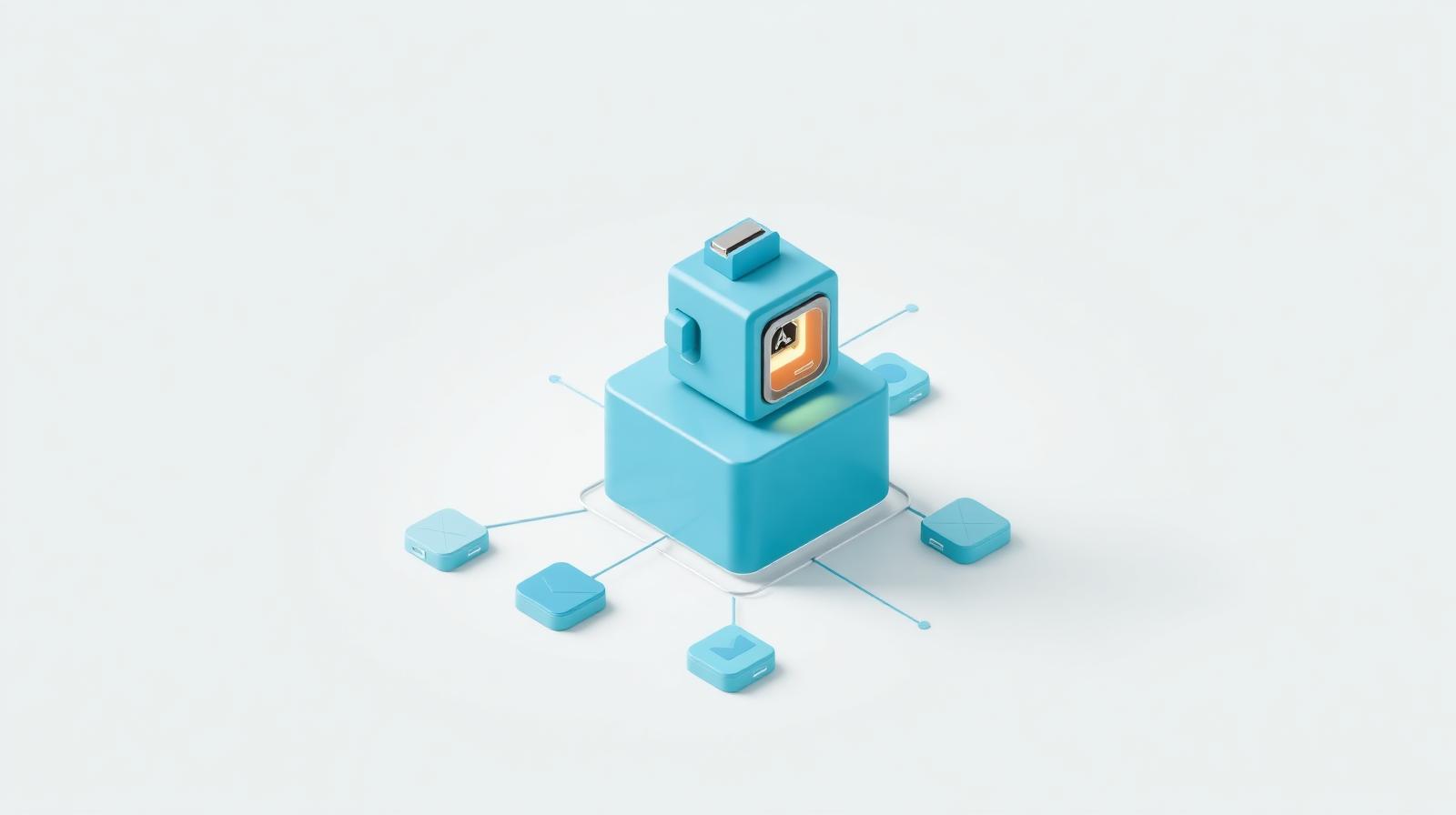
Most AI assistants are stuck behind glass. They will talk about your business all day. They cannot open the file, check the calendar, or send the email. MCP is the thing that breaks the glass.
MCP stands for Model Context Protocol. It is an open standard that lets an AI model plug into your tools and data through one shared connection, instead of every app building its own custom wire. If you have ever wondered why ChatGPT sounds brilliant and then forgets you exist the moment you close the tab, this is the missing piece.
I build AIOS, an AI operating system you actually own. The Tools layer is layer four, and it runs on MCP. Here is what it is, where it came from, and why a second brain without it is just a reader.
Building your own AIOS? Join the waiting list and I will walk you through it, layer by layer.
MCP is the plug that connects any model to any tool.
One standard connection, so the AI can read your files and act in your apps instead of guessing.
Think of an MCP server as a small adapter. It exposes one system, say your files or a GitHub repo, in a standard way. Any MCP-compatible AI can then read from that system and act on it. The official site calls MCP the "USB-C port for AI", and that framing is exact. USB-C standardized the plug, not the device. You stopped carrying six chargers.
Before MCP, every connection was hand-built. If you wanted Claude to read your GitHub and ChatGPT to read your GitHub, that was two separate integrations, written and maintained by hand. Multiply that by every model and every tool and you get the problem the industry called NxM. Build one MCP server, and every compatible model can use it. Write once, plug in anywhere.
The protocol borrows the request and response flow from the Language Server Protocol, the same idea that lets one code editor talk to dozens of programming languages. Boring engineering. That is the point. The boring standards are the ones that last.
From one company's idea to shared infrastructure.
Anthropic open-sourced it in late 2024. Within a year the rivals were all on it.
Anthropic introduced MCP and open-sourced it on 25 November 2024. It shipped with reference servers and SDKs, not just a blog post, which is why developers actually picked it up.
Then something rare happened. Competitors who agree on almost nothing agreed on this. Through 2025, OpenAI and Google both added MCP support to their own products, and the protocol moved to vendor-neutral governance. In September 2025 the official MCP Registry went live, a public catalog where anyone can find servers to plug in.
The numbers tell the same story. Independent directories now catalog more than 49,000 public servers (as of June 2026). A year earlier there were a handful.
That is the part worth slowing down on. A standard is only useful if it outlives the company that made it. MCP now does.
“When fierce rivals all back the same plug, that plug has stopped being a feature and become infrastructure.”
A second brain without MCP is just a reader.
Context plus action is a system. Context alone is a search box with a good memory.
Here is the honest version. You can give an AI your whole life in text: your notes and three years of decisions. It will read all of it and still be unable to do a single thing in your real day, because reading is not reaching.
This is where MCP changes the shape of the thing. With it, the model can pull today's events from your calendar and read the unanswered threads in your inbox. It can edit the actual file in your project folder. The Filesystem and Fetch reference servers do the simple version. The popular ones go further: Microsoft's Playwright server, often near the top of the directory at over 34,000 GitHub stars, drives a real browser and fills real forms. Upstash's Context7 pulls correct, version-specific documentation so the model stops inventing APIs that do not exist. The GitHub server reviews pull requests and triages issues on your behalf.
I felt the difference on a Tuesday. My system pulled my calendar and my email and wrote my morning brief before I sat down. I read it, fixed two lines, and that was the whole edit. First time in years I did not start the day from a blank page. Not magic. Just a model that could finally see the same screen I was looking at.
A second brain that can read everything and touch nothing is a very expensive library card. MCP is what turns the library into an assistant that fetches the book and opens it to the right page.
There is a cost to all this access, and skipping it would be dishonest. A model that can charge a card or post to Slack can also be tricked into doing it. Prompt injection and over-permissioning are real risks, which is why registries, OAuth-based servers and per-team controls are being built right now. Power and exposure arrive together. You design for both or you get burned.
You do not need 49,000 servers. You need a model that can see your real work, and one place to keep your context that no vendor can switch off. That is what AIOS is built to do, and the Tools layer is where it stops reading and starts working.
Join the waiting list and I will walk you through the build, layer by layer. If you want the layer underneath this one first, start with what a second brain actually is.
Egils
- Model Context Protocol (official site): the "USB-C port for AI" framing and protocol overview.
- Anthropic, Introducing the Model Context Protocol, 25 November 2024.
- MCP reference servers (Filesystem, Fetch, Memory and more).
- Official MCP Registry, launched in preview, September 2025.
- Glama MCP directory: public server catalog, 49,000+ listed as of June 2026.
- Microsoft, Playwright MCP server (browser automation, 34,000+ stars).
- Upstash, Context7 MCP server (version-specific docs).
- GitHub MCP server (official).

Entrepreneur from Latvia. Building FullDigital so people stay free in the age of AI. I write about what actually works in my own week, not what sounds good on a conference stage.
Connect on LinkedIn