
Here is a small experiment. Open a generic AI and ask it about something real in your life. A decision you are weighing. A message you need to send. A plan for next week. Read the answer. It is competent. It is also generic. It could have been written for anyone.
That is not the model being weak. That is the model not knowing you. It meets a stranger every time you open a new chat, so it gives the answer it would give a stranger.
The fix is the most underrated move in this whole field. And it takes one file.
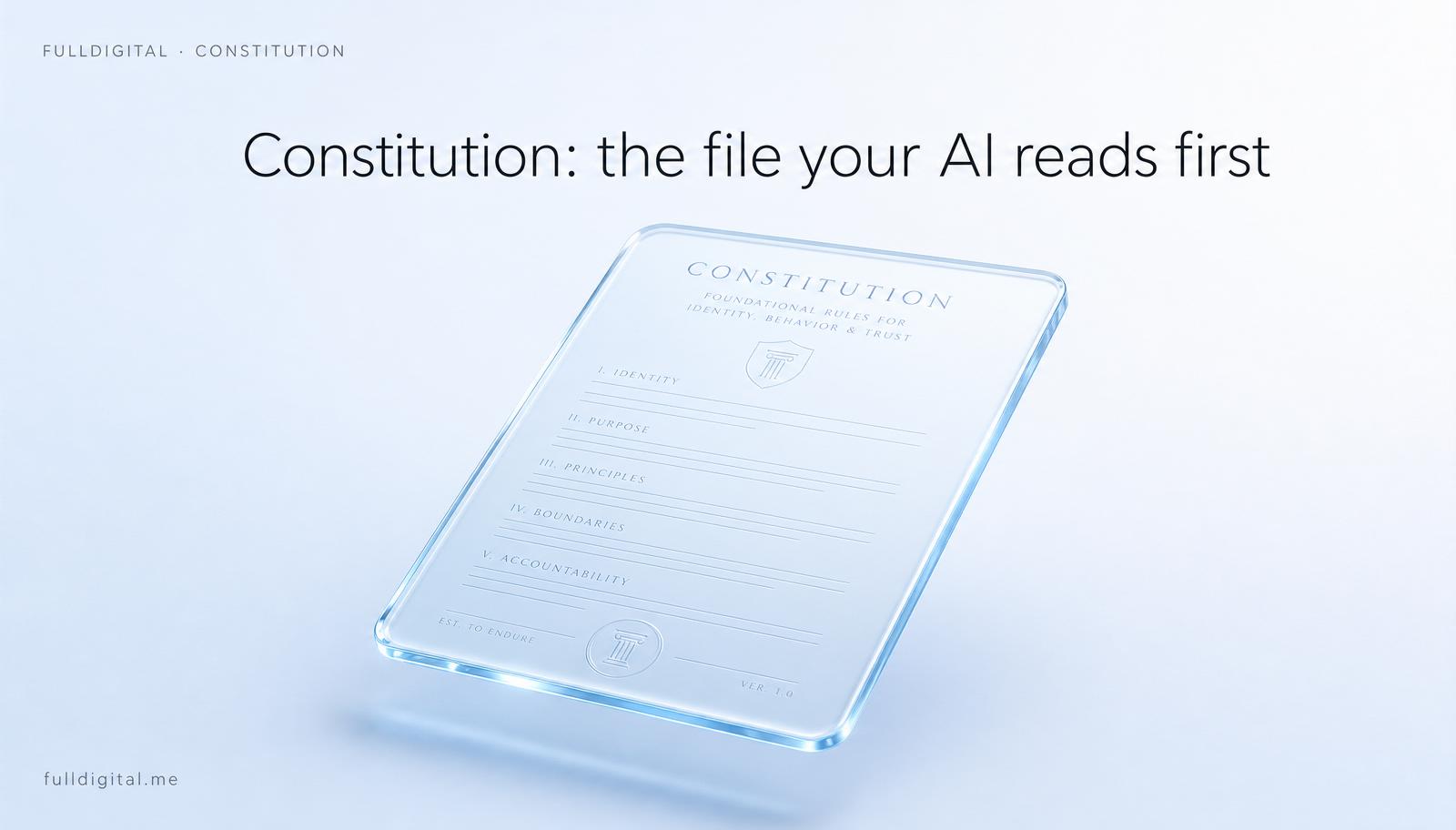
Call it your Constitution. Some people call it a system prompt, ChatGPT calls it custom instructions, Claude calls it a system message. Same idea. It is the file your AI reads first, before anything else, every session. It says who you are, what you are working toward, how you think, and how you want it to talk with you. Not a thousand facts. Just the stable core. The part of you that does not change with the task in front of you.
Everything downstream inherits it.
Once the system knows your situation, your standards and your voice, every answer is filtered through them. Generic advice becomes advice for you. A draft sounds like you wrote it. A plan respects what you actually care about, instead of optimising for something you do not. You stop correcting the same things over and over, because the corrections are baked into the foundation.
The instinct has serious backing. Anthropic built an entire research direction on the idea that a written set of principles can shape how a model behaves, and published it as Constitutional AI in 2022. That paper is about training a model, not about your personal system prompt, but the analogy is the right one: principles written down, loaded first, shape everything that follows. The lab uses a constitution to align Claude. You can borrow the same instinct to align an off-the-shelf model with one person: you.
It is also the cheapest edge you will ever get from AI. People spend hours engineering the perfect prompt for one task, then throw it away and start from zero tomorrow. A Constitution is the opposite of disposable. Write it once. It pays off in every conversation after, for as long as you use AI, across whatever model you happen to be on.
That is the quiet superpower of writing it down. The next model you switch to inherits the same you. Your system stops starting from zero every time the tooling changes underneath it. And the tooling will keep changing. That is a safe bet for the next 10 years.
Short. Specific. A little opinionated.
The mistake is to write a bland corporate bio. The kind you would put on a website. That gets you a bland corporate assistant. A good Constitution sounds like you on an honest day. It names what you genuinely care about and what you would never do, not what sounds impressive. The blunt ones work best, because vague inputs produce vague outputs. "I value growth and excellence" tells the AI nothing.
As Andrej Karpathy put it, the hottest new programming language is English. Your Constitution is the program. Write it like you mean it.
Keep it small. Change it rarely. This is not where everything you know lives. It is where the things that are true about you regardless of the task live. When you find yourself wanting to add this week's project or a passing idea, that is a sign it belongs somewhere else. The AI loads the Constitution first. You do not want your foundation buried under noise.
A useful test: if a sentence in your Constitution would still be true a year from now, it belongs. If it might be false next month, it does not.
“Write it once. It pays off in every conversation after, across whatever model you happen to be on.”
Identity first. Facts later.
Who you are goes in the Constitution. What is happening in your life goes in your memory. People blur these constantly, and the result is a system that knows a hundred facts about them and still answers like a stranger. The part that makes it sound like them was never actually written down.
Identity first. Facts later. In that order. Get that split right and the rest of your AI system has somewhere stable to stand.
You can see it yourself. Every time you open a chat and feel like you are explaining yourself from scratch, that is a Constitution problem. Every time you feel like the AI forgot something specific you told it last week, that is a memory problem. Two different layers. Two different fixes.
You do not need anything fancy to start. A single honest page that says who you are and how you want your AI to work with you will change the next conversation you have.
That is the test. Write it. Load it as your system prompt or custom instructions in whichever tool you use. Watch the answers stop sounding like they were meant for everyone else.
The Constitution is layer one of the AIOS. The next thing to read is the Constitution layer, where this stops being theory and turns into the actual file on your disk.
And if this resonated, that is roughly why we are building FullDigital. A small group of people building their own AIOS, layer by layer, with us. Come hang out on the waiting list. No pitch, no spam. Just early access and the conversations as we go.
- Bai et al., Constitutional AI: Harmlessness from AI Feedback, Anthropic, 2022. The mechanism is model training, not a user system prompt; cited here as an analogy for a personal constitution, not the same mechanism.
- Andrej Karpathy, the hottest new programming language is English, January 2023.
- Andy Clark and David Chalmers, The Extended Mind, Analysis, 1998.
- OpenAI, System messages and Custom instructions for ChatGPT.
- Anthropic, System prompts for Claude.
- David Allen, Mind Like Water, on clarity through an external system.
- GDPR, Article 20: Right to data portability, the legal backing for keeping your Constitution in plain files you own.

Entrepreneur from Latvia. Building FullDigital so people stay free in the age of AI. I write about what actually works in my own week, not what sounds good on a conference stage.
Connect on LinkedIn